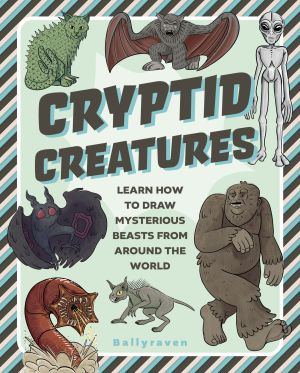
Cryptid Creatures: Learn How to Draw Mysterious Beasts from Around the World
I have to begin this review with a severe disclaimer. I would not refer to myself as someone who can draw. I can paint a little, but I just can’t draw. You tell me to draw a circle? I draw a potato. You tell me to draw a straight line? I draw an electrocardiogram. You tell me to draw Mothman? I draw a mothball. Therefore, I was excited to dig into Cryptid Creatures: Learn How to Draw Mysterious Beasts from Around the World, a cryptid drawing tutorial book – because if I can draw it, so can the average 7-year-old.
Authored by Ballyraven, the blue cryptid-hunting magical bird alter ego of an Appalachian illustrator named Kristen, Cryptid Creatures promises aspiring artists 35 step-by-step tutorials to draw cryptids, hoax creatures, prehistoric animals, and more.
A stand-out element of the book is its front matter. In addition to teaching interested artists how to draw cryptids, Ballyraven also teaches them about cryptids. The introduction to the volume explains some common types and anatomy, while the tutorials themselves include information specific to each cryptid. Helpfully, as you draw along, the various steps explain why you’re doing what you’re doing. For example, in the tutorial to draw a Bunyip, step three explains that the drawing will combine all three types of Bunyip sightings, such that the finished drawing will include tusk-like teeth, wrinkled skin, large eyes, and whiskers.
The front matter also offers some general tips and pointers about how to draw. Ballyraven does a good job approaching this from a balanced perspective, stressing you don’t need fancy materials or ideal papers to enjoy drawing cryptids while also still making some accessible recommendations for beginner artists who want to experience with art supplies.
An index of all the potential cryptids closes out the front matter, listing seven categories of beasties ordered from easiest to hardest to draw within each category. Those categories include: desert-prowling cryptids, mountain-trekking cryptids, swamp-lurking cryptids, water-dwelling cryptids, forest-creeping cryptids, night-seeking cryptids, and high-flying cryptids. There’s a good balance of recognizable creatures for the casual cryptozoologist, while still introducing some more obscure options that offer different types of drawing potential. The only drawback here is a majority of the creatures included are colored realistically to their environments, so the colors overall can look a little same-y and dominated by earth tones. That said, there’s nothing stopping you from painting your Sasquatch magenta.
But the real test of a cryptid drawing tutorial book is: Can it teach you to draw a cryptid? In order to find the truth, I chose a creature to feature and got to drawing. I selected Wolpertinger, a German faux creature that’s a hybrid of squirrel, rabbit, deer, and pheasant.
The tutorial has nine steps and when I started, I guesstimated I would crumble into dust around step six. But you never know until you try.
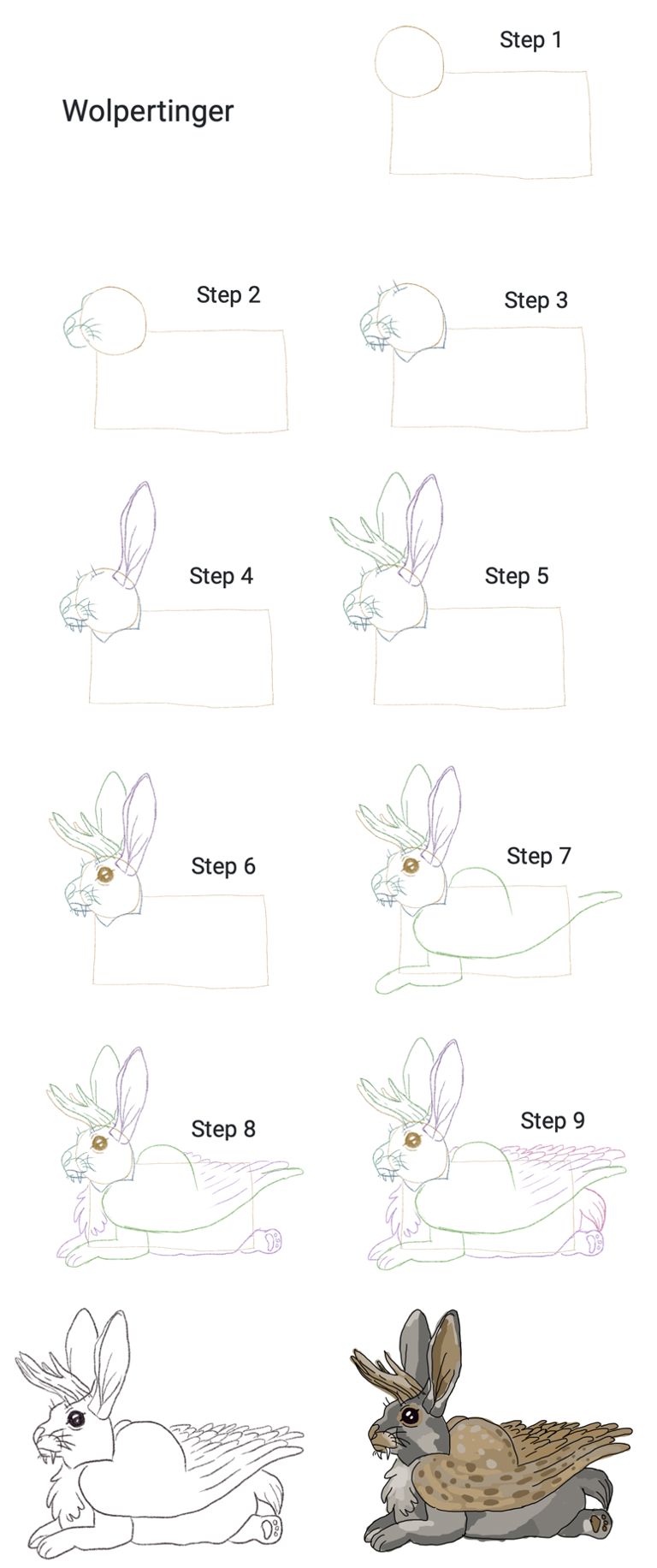
For the most part, the tutorials follow a similar structure: outlining some reference shapes, tackling specific parts of the cryptid separately, erasing guidelines, and emphasizing with a strong outline.
The tutorials are easy to follow with intentional color variation for each new element.
Each step details what to do in text, but also in image. I found the image itself easier to follow from the text, but it’s always good to have options.
By the time I got to the dreaded step 6, I was pleased to find that my efforts did indeed resemble the face of an animal.
Each step was additive, but not overwhelming. As the creature came together, it also became clearer how the anatomy of the animal functioned, making it easier to draw.
Step 9 officially concluded the tutorial with the instructions to erase the reference sketch lines. Outlined in black, the finished result is on the bottom right, though I quickly added some color to resolve the Wolpertinger in his fullest glory, referring back to the image at the beginning of the tutorial for color notes.
It took me about 20 minutes from start to finish and I was immensely happy with the result.
Overall, Cryptid Creatures is a well-rounded introductory art book, though some of the cryptids proved a little harder to draw than I anticipated when it came to drawing more organic shapes like fur and hair. You end each tutorial with an outlined creature, and while this could leave some readers adrift without a strategy to add color and depth, it also allows for personal creativity and re-drawability.
I would recommend this book for aspiring young artists, adult artists who could use the help, and cryptid enthusiasts.